Bitcoin Exchange Reserves Hit Historic Lows: A Shift Toward Long-Term Holding
Bitcoin exchange reserves have reached unprecedented lows, signaling a notable shift in investor behavior. This trend, accompanied by rising institutional interest and a changing regulatory landscape, points to growing confidence in Bitcoin as a long-term asset. Let’s explore the data, its implications, and the broader market context.
A Steady Decline in Exchange Reserves
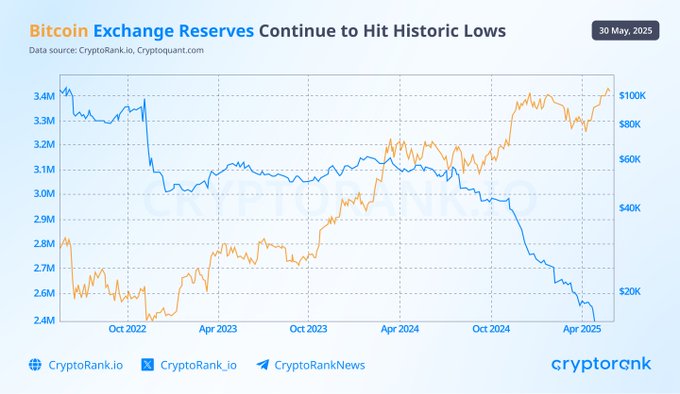
Data from CryptoRank.io shows Bitcoin exchange reserves dropping to their lowest levels on record. The chart below tracks this decline, with reserves falling from 3.3 million BTC in October 2022 to just over 2.3 million BTC by May 2025—a significant reduction over the past two and a half years.
Source: CryptoRank.io
This downward trend indicates that investors are increasingly withdrawing Bitcoin from centralized exchanges, likely moving their assets to cold storage for long-term holding. Such behavior suggests a preference for non-custodial storage, minimizing exposure to risks associated with centralized platforms, such as hacks or regulatory actions.
Why it matters: Lower exchange reserves often reduce selling pressure, as fewer coins are readily available for trading. Historically, this trend has been associated with accumulation phases, where investors hold Bitcoin off exchanges in anticipation of future price increases.
Institutional Buying Fuels the Trend
The decline in exchange reserves aligns with a surge in institutional interest. According to Blockchain News, a Bitfinex whale has been purchasing Bitcoin at an average rate of 375 BTC per day, with peaks reaching 1,000 BTC. Meanwhile, Bitcoin ETFs and MicroStrategy are acquiring Bitcoin at a rate four times the daily mined amount of 450 BTC. This aggressive buying from institutional players underscores the shift toward long-term holding, as these entities typically store their assets off exchanges to secure their investments.
Why it matters: Institutional accumulation can drive scarcity, potentially pushing Bitcoin’s price higher as supply on exchanges dwindles.
Regulatory Shifts Reduce Centralized Risks
The timing of this trend coincides with a notable regulatory development: the U.S. Securities and Exchange Commission (SEC) dismissed its lawsuit against Binance on May 29, 2025, as reported by The New York Times. The lawsuit, initiated in 2023, had accused Binance of illegally serving U.S. users and misusing customer funds. Its dismissal may reduce perceived risks associated with centralized exchanges, encouraging more investors to move their Bitcoin to cold storage while regulatory clarity improves.
Why it matters: A more stable regulatory environment can boost investor confidence, making long-term holding a more attractive strategy.
Market Impact: Upward Price Pressure
The reduction in exchange reserves is already influencing Bitcoin’s price. According to The Block, Bitcoin has surged past $104,300, trading at a “pivot point” of $105,500. This upward movement suggests that lower exchange reserves may be contributing to price pressure, as reduced supply on trading platforms limits selling availability while demand remains strong.
Why it matters: If this trend continues, Bitcoin could see further price appreciation, especially as institutional buying persists and retail investors follow suit.
Global Context: India’s Regulatory Outlook
On a global scale, India is preparing a crypto policy discussion paper for June 2025, signaling a potential shift toward a more open stance on digital assets, as noted by The Hindu. This follows a May 2025 Supreme Court remark questioning the lack of clear crypto regulations despite existing taxes. A more favorable regulatory framework in India could further boost investor confidence worldwide, encouraging long-term holding as part of a broader global trend.
Why it matters: Regulatory clarity in major markets like India can create a ripple effect, reinforcing Bitcoin’s appeal as a long-term investment.
Conclusion: A Maturing Market
The historic low in Bitcoin exchange reserves reflects a maturing market, where investors—both institutional and retail—are increasingly prioritizing long-term holding over short-term trading. Supported by rising institutional demand, a shifting regulatory landscape, and upward price momentum, this trend underscores Bitcoin’s growing role as a store of value. As global markets like India move toward clearer regulations, the case for holding Bitcoin off exchanges may strengthen further, potentially shaping the cryptocurrency’s trajectory in the months ahead.